Why the next generation of automotive manufacturing will be defined by the partnership between human expertise and intelligent automation, powered by a sustainable blend of traditional and emerging energy technologies.
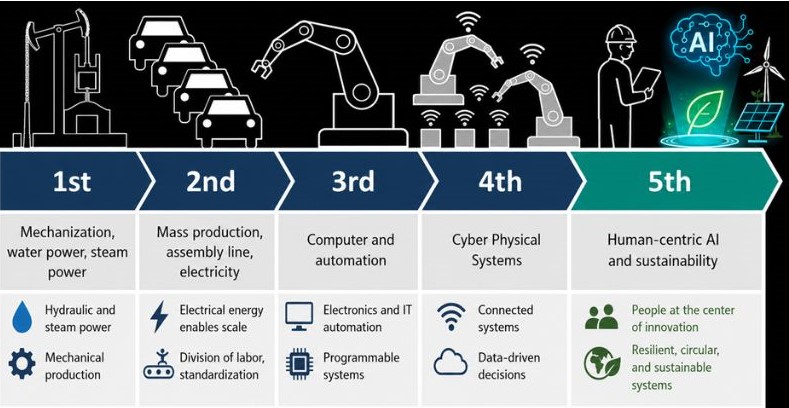
For much of the last decade, manufacturing has been driven by the principles of Industry 4.0. Sensors, robotics, connectivity and advanced analytics have transformed production lines, delivering unprecedented levels of efficiency, precision and automation. Yet as manufacturers face growing pressure to reduce emissions, improve resilience and address workforce challenges, a new industrial paradigm is emerging.
Industry 5.0 represents the next step in this evolution. It builds upon the digital foundations of Industry 4.0 – but also shifts the focus from automation alone towards a more balanced vision. This is one where technology empowers and augments people, supports sustainability, and drives to create more resilient manufacturing systems. Rather than merely replacing workers with machines, Industry 5.0 places human expertise and decision-making at the centre of intelligent, connected production environments. This vision is particularly relevant to automotive body and component manufacturing, where high-throughput productivity, quality, and sustainability must coexist alongside small margins for manufacturers.
Few sectors illustrate this situation better than in automotive press shops. Modern body panel production relies on large stamping presses, complex dies and precision, rapid pressing and forming operations along with deburring, cleaning and finishing. Historically, manufacturers have sought greater productivity through increasing levels of automation. Automated CNC/cutting machines, and materials/parts handling equipment can aid with demanding quality and productivity requirements. Today, the challenge is broader: delivering higher output through continuous fault-free operation, with superior quality and with lower environmental impact (both in terms of emissions and waste materials) simultaneously. This is where human-centric automation comes into its own.
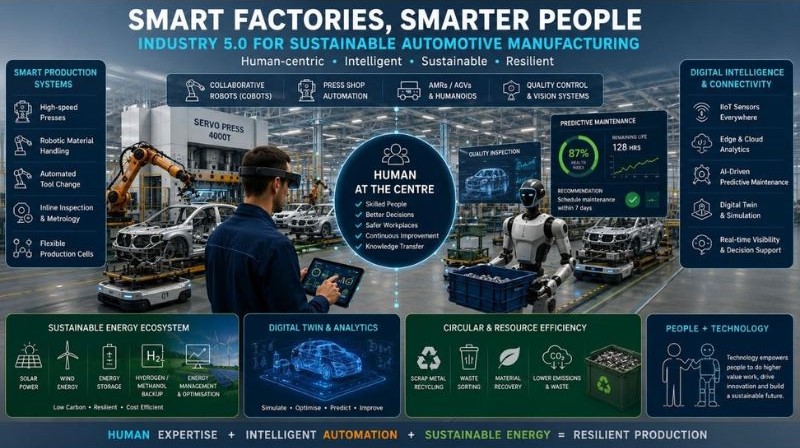
In the Industry 5.0 factory, collaborative robots (cobots) work directly alongside highly skilled operators and technicians/engineers. Repetitive and ergonomically demanding tasks such as loading and unloading heavy press tools with sheet materials or formed components becomes an operator-supervised task accomplished by intelligent robotic assistants. Cobots can load blanks into presses, remove finished panels, position parts for inspection, and gather and sort waste streams – allowing workers to focus on process optimisation, quality assurance and continuous improvement. The objective is not workforce replacement but workforce augmentation: using automation to amplify human capability. This approach reflects the Industry 5.0 vision of collaborative robotics enhancing human skills and workplace wellbeing.
Beyond individual workstations, autonomous mobile robots (AMRs), automated guided vehicles (AGVs) and emerging humanoid robotic systems are transforming factory logistics. Automotive production depends on the continuous movement of tools, dies, materials, and finished components between production areas. Modern facilities are increasingly rely upon intelligent mobile systems capable of delivering tooling, replenishing materials, sorting and recycling waste streams, and supporting optimized just-in-time manufacturing operations. As these technologies mature and penetrate further, gaining further human acceptance, they will help reduce non-value-added activity while improving efficiency, safety, and production flexibility.
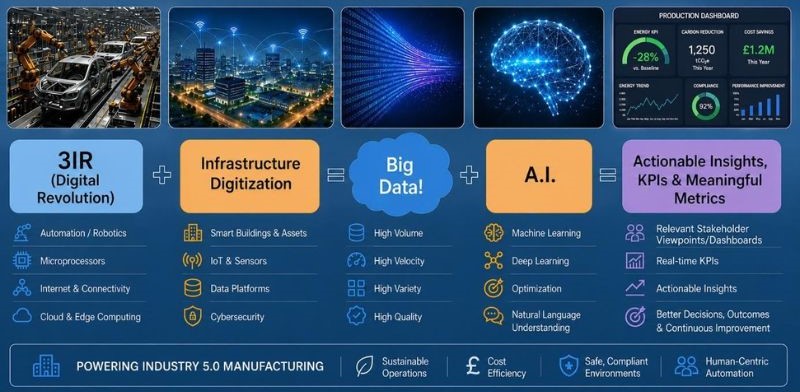
Underpinning these developments is a rapidly expanding digital ecosystem. The Industrial Internet of Things (IIoT) acts as the virtual glue connecting machines, production systems, supply chains, and people. Sensors embedded throughout equipment collect data relating to tool wear, vibration, temperature, energy consumption, emissions, equipment loading, and product quality. Combined with edge computing and cloud-based analytics, this provides unprecedented visibility into factory operations and creates opportunities for proactive decision-making.Digitalisation of supply chains and inventory activities allows further integration of business operations to the shop floor, and collection of data needed for intelligent decision making and enablement of smart contracts and ESG/regulatory compliance reporting.
One of the most valuable applications is predictive maintenance. Consider a transfer press showing early signs of bearing wear or tooling degradation. In a traditional environment, the issue may remain undetected until a costly breakdown occurs. In an Industry 5.0 facility, AI-based analytics identify abnormal trends, estimate remaining component life and alert maintenance teams before failures develop. Engineers equipped with augmented reality (AR) headsets can access digital maintenance records, three-dimensional equipment models and guided repair procedures while standing directly in front of the machine. The result is reduced downtime, faster fault diagnosis, and more effective transfer of knowledge between experienced engineers and newer employees. Crucially, the human Engineer is in charge in such a situation: provided with key insights and the ability to dynamically pull drawings and specifications, more informed decisions regarding specific tools, parts, and expected downtimes can be delivered,
These capabilities become even more powerful when combined with digital twins. Virtual representations of machines, production lines and entire facilities enable manufacturers to test operational changes before implementing them physically. Press settings, material flows, maintenance schedules, and energy management strategies can all be evaluated in a risk-free virtual environment. This supports the transition from reactive factories to anticipatory factories driven by data and intelligent decision support.
Yet Industry 5.0 is about far more than productivity. Sustainability also sits at its core.
Automotive manufacturers face increasing pressure to reduce emissions, minimise waste and improve resource efficiency throughout their operations. Energy-intensive activities such as stamping, welding, painting, heat treatment and material handling contribute significantly to overall environmental impact. Intelligent manufacturing systems provide powerful opportunities to optimise energy consumption while maintaining production performance via locally integrated energy ecosystems. Local microgrids combining grid electricity, solar photovoltaics, wind generation, battery energy storage, and locally-fuelled generation (diesel, methanol, biomass, etc), can improve both resilience and sustainability. AI-driven energy and waste management systems will continuously optimise operations, balancing production requirements against energy cost, carbon intensity and renewable availability. Waste streams may be sorted and valorised into useable fuel sources for local energy generation. Rather than viewing manufacturing and energy as separate challenges, Industry 5.0 integrates them into a single optimisation framework.
Alongside electrification, alternative fuels are expected to play an important role. Hydrogen may eventually provide low-carbon fuel for industrial heating applications, while methanol and other sustainable fuels can support local power generation and backup energy systems, and eventually can replace diesel. Intelligent control technologies will help manufacturers determine the most efficient and sustainable energy mix based on availability, cost, and operational requirements.
Carbon management technologies will also become increasingly important. Carbon Capture, Utilisation and Storage (CCUS) systems are beginning to emerge across major industrial clusters, creating opportunities for manufacturers to reduce emissions further, maintaining competitiveness through valorisation and recovering of unused hydrocarbons from waste CO2 streams and carbon tax reductions for local or export markets. Combined with renewable power, energy storage, and alternative fuels, such technologies as they mature and become more efficient, will help accelerate the transition towards more sustainable and cost-effective production.
Importantly, however, the success of these innovations will depend on people. Data scientists, maintenance engineers, operators, production managers and sustainability specialists will all play critical roles in designing, operating and improving future manufacturing systems. The greatest value of AI, robotics and automation lies not in autonomy for its own sake, but in empowering people to make better decisions, solve more complex problems and create safer, cleaner and more productive workplaces. This principle lies at the heart of the transition from Industry 4.0 to Industry 5.0, where technology and human creativity work together rather than in competition.
The automotive factories of the future will therefore not be defined by machines alone. They will be intelligent, connected, and sustainable environments where cobots assist operators, AGVs move materials, AI predicts and prioritises production bottlenecks, efficiency chokepoints, and maintenance needs for operators and engineers to check, a blend of traditional and emerging energy sources powers production, and IoT data supports every decision. Above all, they will be places where technology enhances human potential.
That is the true promise of Industry 5.0: smart and sustainable factories made possible by even smarter people, unlocked by technological and educational innovation.